
Communication for People Living with MND
Recent Work
Tinkerabl AAC
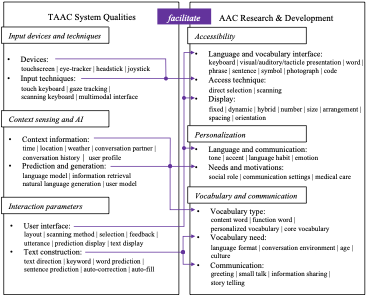
People living with MND (plwMND) often rely on Augmentative and Alternative Communication (AAC) systems to communicate. Due to the heterogeneity of the users who have diverse needs depending on many factors, such as motor ability, congnition, age, educational, and overall performance. Tinkerable AAC (TAAC) has the potentiial to empower AAC users, developers, and researchers to fine-tune, adapt, and explore better communication solutions in tandom with the system.
Eye Typing
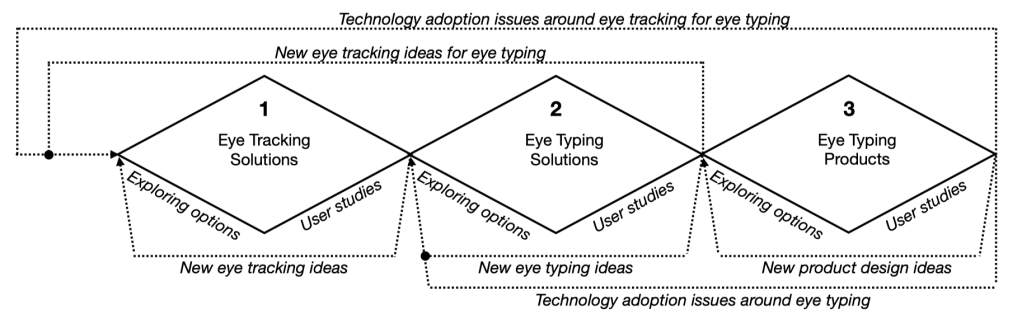
Gaze interaction enables users to communicate through eye tracking, and is often the only channel of effective and efficient communication for individuals with severe motor disabilities. We provide a systematic understanding of the components and functionalities that underpin eye typing solutions, and analyze the interplay of the different facets and their role in shaping the user-experience, accessibility, performance, and overall effectiveness of eye typing technology. We also identify the major challenges and highlight several areas that require further research attention.
Chinese Dysarthria Speech Database

Chinese Dysarthria Speech Database (CDSD) is a valuable resource for dysarthria research. This database comprises speech data from 24 participants with dysarthria. Among these participants, one recorded an additional 10 hours of speech data, while each recorded one hour, resulting in 34 hours of speech material. This research indicates that through extensive data-driven model training, fine-tuning limited quantities of specific individual data yields commendable results in speaker-dependent dysarthric speech recognition.
Computational Design Methods

AAC systems are notoriously difficult to evaluate with end-users, and we want to be less intrusive to them. The function structure model, along with the envelope analysis method, provide designers a computational approach to explore and evaluate potential design space at the early design stage.
 AIDA Association